

Skip to content

Cart

Your cart is empty

Help Centre

Mānuka Honey

Find answers to our most common questions.

What does MGO mean on Mānuka Honey?

MGO stands for methylglyoxal, a naturally occurring compound found in Mānuka Honey. The number on the jar, such as MGO 100+ or MGO 830+, is the minimum amount measured in that batch, in milligrams per kilogram. The higher the number, the rarer the grade. Every Egmont batch is independently tested before it's labelled.

What's the difference between MGO and UMF™?

MGO (methylglyoxal) is the natural compound that gives Mānuka honey its unique properties. The higher the MGO number, the rarer the grade. UMF™ is a wider certification from the UMF™ Honey Association that tests four key markers to confirm the honey is genuine Mānuka. Our UMF™ certified jars show both grades on the label.

What's the difference between monofloral and multifloral Mānuka Honey?

Monofloral Mānuka comes mostly from Mānuka flowers and meets New Zealand's official scientific definition, which tests for four natural markers and Mānuka pollen DNA. Multifloral Mānuka contains Mānuka alongside other native New Zealand flowers, so it's lighter and sweeter. Our MGO 40+, 70+ and 100+ are multifloral, and our grades from MGO 200+ upwards are monofloral.

Which Mānuka Honey grade should I choose?

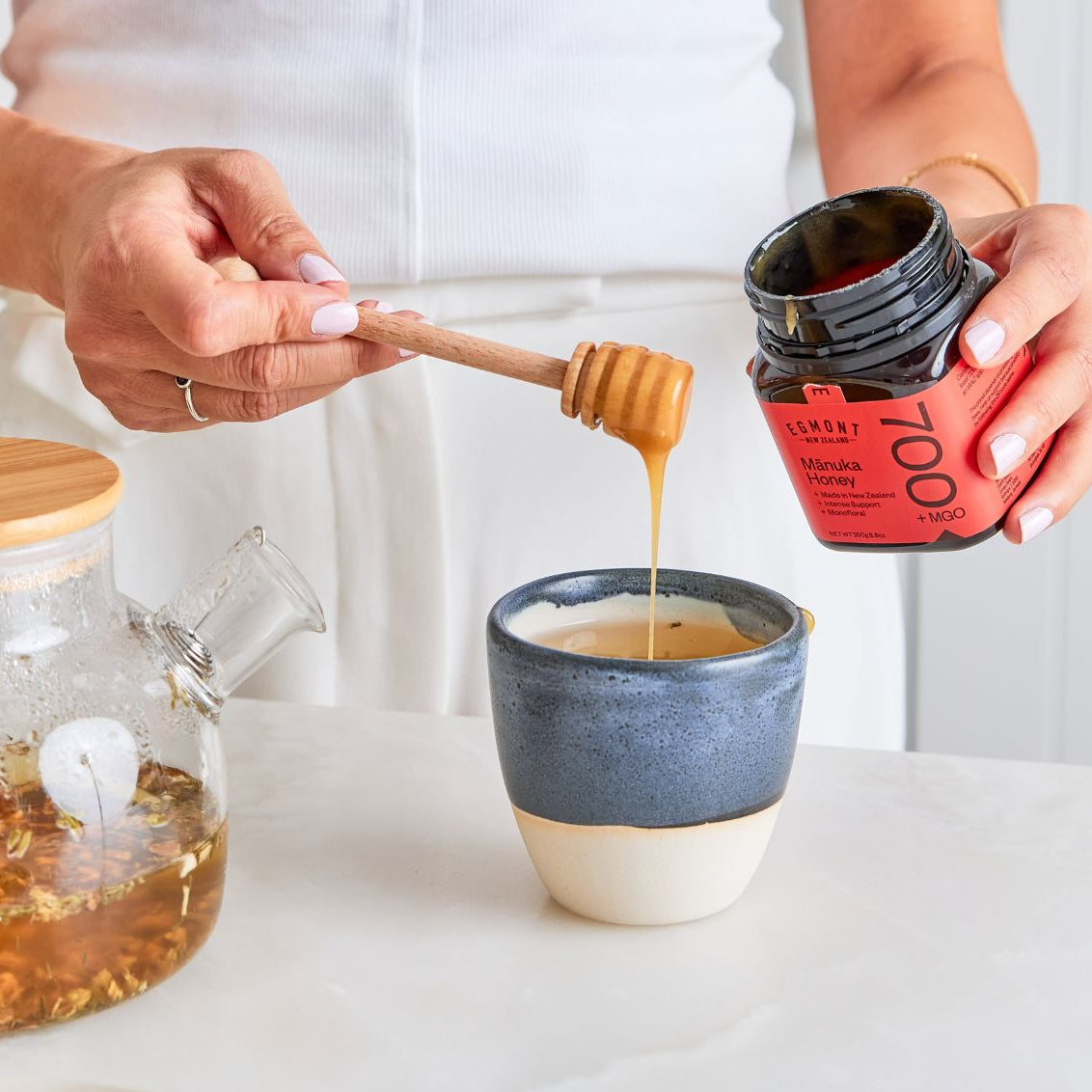
It depends how you'll enjoy it. Our Everyday range (MGO 40+ to 100+) is mild and creamy, ideal for toast, baking and warm drinks. Elevate (MGO 200+ to 400+) is richer and made for a daily spoonful. Intense (MGO 700+ and 830+) and Ultra (MGO 1046+ and 1200+) are our rarest, boldest grades. Not sure? Take our 60-second grade quiz.

How should I store Mānuka Honey?

Keep it sealed in a cool, dry cupboard, out of direct sunlight. There's no need to refrigerate it, because the cold just makes it firmer and harder to spoon. Use a clean, dry spoon each time to keep moisture out of the jar.

Why has my Mānuka Honey gone thick or set?

It's completely natural. Honey can slowly set over time as its natural sugars crystallise. It doesn't change the quality or the MGO level on the label. To soften it, stand the jar in warm (not hot) water for a few minutes.

Is Mānuka honey suitable for children?

Like all honey, it isn't suitable for babies under 12 months. From 12 months it can be enjoyed as part of a varied diet.

Is Mānuka Honey vegan?

Honey is made by bees, so it isn't vegan by most definitions. It is suitable for vegetarians.

Still need help?

Our team aims to respond within 24 hours, Monday to Friday.